The Project One initiative to deploy Workday originated from a vision for “the System to operate even more like a System.” By bringing the member institutions of the System onto one common platform for major administrative business functions, the System could realize better alignment and easier exchange of data between the institutions: one System, one solution.
Functional Scope
Core administrative functions for finance, human capital management, payroll, and student administration were replaced with Workday:
| Financial Management | Human Capital Management | Student Administration |
|---|---|---|
| Core Financials | Core Human Capital Management | Admissions and Recruitment |
| Expenses | Benefits | Advising and Degree Audit |
| Grants Management | Recruiting | Financial Aid |
| Project Billing | Time Tracking | Student Accounting |
| Procurement | Payroll | Student Records |
| Projects | Learning | Student Services |
| Inventory | ||
| Adaptive Planning |
Deployment Timelines
Workday for Financial Management and Human Capital Management was implemented using a multi-phase approach, originally organized into two main cohorts. The COVID-19 pandemic required UAMS to push their go-live from 2021 to 2022. Other supplemental Workday products, such as Prism Analytics, Adaptive Planning, and Extended Enterprise Learning were live by the end of 2022. University of Arkansas Grantham transitioned to Workday in 2024 after joining the UA System in 2023.
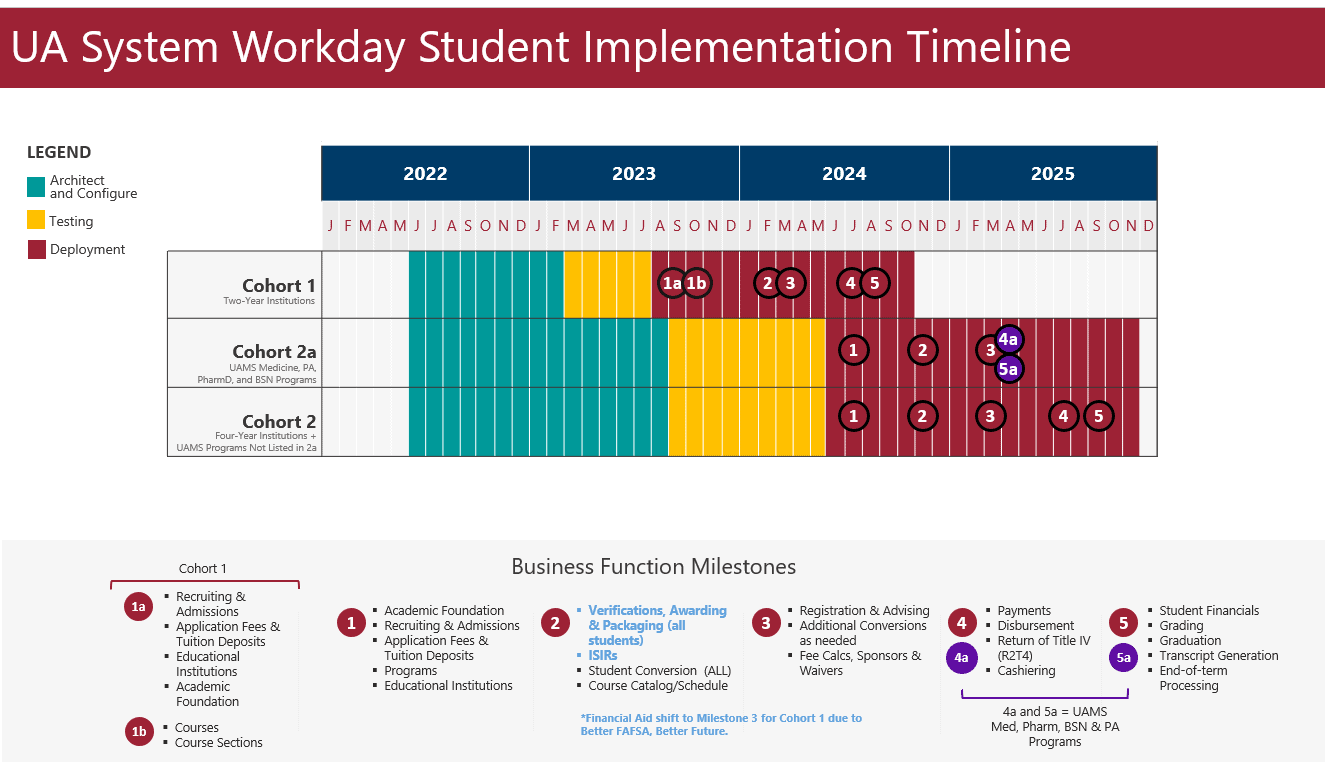
The implementation of Workday Student followed and was organized into two main cohorts, deploying over five major milestones. All 14 campuses serving students are live as of August 2025.
Project History
Getting Started
In 2014, the Board of Trustees of the University of Arkansas engaged BerryDunn to conduct an Information Technology Assessment for all campuses and units of the University of Arkansas System.
The Board’s purpose was to assess IT System-wide and identify opportunities to reduce costs, create operational efficiencies and improve security.
Top Recommendation: “The University System should consider moving to a shared ERP platform over time. Moving to common and shared ERP products requires careful and deliberate discussion and planning. It can lead to cost reductions and operational efficiencies but requires significant change for people and processes at the institutional level. Currently several System schools are considering, or will need to consider, new ERP systems because the current system is at end-of-life.”
At the Board of Trustees Annual Retreat in August 2015, the Board charged the President to move forward with the project. The President met with his cabinet of Chancellors in September 2015, and support to move forward with project was unanimous.
The Council of UA Campus CIOs was asked to serve as the RFP Evaluation and Selection Committee, to select a consulting group to guide the project. An RFP was issued in October 2015 and the Committee recommended awarding the consulting engagement to ISG Public Sector in January 2016.
ISG’s scope of services included: support the University with design of an ERP procurement strategy, development of system requirements, preparation of RFPs, vendor evaluation/selection, and contract negotiations, with an option to provide advisory oversight services during deployment.
Procuring Software
The RFP for ERP Solution was published on October 7, 2016 and proposals were due on December 16, 2016. The Evaluation Team reviewed five proposals, participated in week-long software demonstrations with three finalists, and posted an Intent to Award to Workday in August 2017.
Procuring Service
The RFP for ERP Implementation Services was released November 1, 2017 and proposals were received on December 14, 2018. The Evaluation Team reviewed proposals and conducted interviews in the spring of 2018 with an Intent to Award by June 1, 2018.
Following a competitive procurement, Deloitte Consulting, LLP was selected as our system integrator due to its significant experience in Workday implementations, particularly in higher education HCM, finance and student administration. The Project One team was enhanced by Deloitte’s experienced leadership, and the commitment of the functional and technical professionals who collaborated with the UA System team. Each resource brought considerable knowledge to Project One that contributed to the overall effectiveness of this endeavor. To learn more about Deloitte’s Higher Education practice, click here.
Implementation Preparation
When the project was still in the procurement phase, there were several activities that the UA System conducted to prepare for the important implementation project. Each of these items was a critical piece of the foundation for the new system.
Financial Structure
The UA System formed a cross-institution work team to brainstorm and define a new financial reporting structure and financial chart of accounts that will be deployed with the implementation of Workday. The team met during the fall of 2016 and reported its results early in 2017. This new structure was expected to:
- Provide a mechanism to perform university system wide financial reporting
- Capture financial data at a meaningful level of detail to assist each Institution in managing its financial resources
- Identify the components and levels of detail available to capture and report financial data
Note that this proposed structure did not attempt to define input coding. The input coding block and coding reduction techniques were determined by the selected software.
Interface Data Gathering
The Steering Committee authorized ISG to collect and collate information from all participating institutions about existing systems that would need to exchange data with the new Workday solution. The exact scope would not be known until Workday had been designed and configured.
The process was initiated with a Current Systems Assessment done in 2015. ISG validated the initial list in 2016 and collected additional data elements for each integration point. By gathering and organizing this data set, the project saved the time and expense of waiting for this information to come together during implementation.
Pre-Implementation Questionnaire
A pre-implementation questionnaire was designed to address questions about business rules, processes and procedures. This information was collected, collated and analyzed pre-implementation to focus implementation effort later and reduce implementation risk. Many staff throughout the System worked on the questionnaires to help develop an inventory of how the UA System operates. ISG collated the information and scheduled harmonization sessions to better align all of the institutions. Benefits of this activity included:
- Driving standardization and disciplined decision-making process across the organization
- Extending the implementation decision-making window and encourage consideration of institutional objectives
- Allowing institutions more time to gather information
- Allowing implementation and refinement of a collective and disciplined decision-making process
- Reducing the number of decisions needed once the implementation began, and thereby reducing the likelihood of implementation delays and cost overruns
This process shouldn’t be confused with the Project One design sessions that took place during the Architect stage. The design sessions were more specifically focused on how Workday would be configured and used based on how the UA System operates.
Vision, Goals, and Guiding Principles
Vision
Project One will implement an integrated and highly efficient Human Capital Management (HCM) and Finance system that meets the critical business requirements of the UA System members by eliminating outdated and redundant systems, maximizing the efficiency of managing System resources, enhancing security and ensuring transparency. The project will mirror the UA System’s excellence in teaching, research, and service, making it easier for faculty, students and staff to achieve their goals.
Developed with broad community engagement across all the members of the System, Project One will be defined by easy to use systems that lower the administrative burden for all, deliver trusted information, and reduce overall costs.
Goals
- Acquire a modern ERP solution that effectively processes the volume and type of transactions required by the System;
- Improve the efficiency of administrative operations;
- Implement user-friendly intuitive systems for use system-wide;
- Deploy a shared system-wide chart of accounts to align reporting and simplify consolidation;
- Expand and simplify management access to detailed information;
- Provide smooth and seamless integration between Project One and other systems used by the campus community;
- Replace aging technology infrastructure and custom software; and
- Take advantage of continuing advancements in functionality and technology that would enable future improvements in business and administrative practices.
Guiding Principles
- Operate as a System
- As common as possible, as different as necessary
- Ensure one system of record
- Provide support to stakeholders during transition
- Crawl. Walk. Run.
- Consolidate integrations when possible
- Minimize legacy data conversion
- Develop a common platform for future development
- Enable enhanced quality and access to information
- Monitor key performance measures
Project Team Organization

Executive Committee
The Executive Committee, comprised primarily of UA System Office senior leadership, provided strategic direction for Project One and promoted the long-term vision of the project.
Steering Committee
The Steering Committee consisted of senior leadership from across many institutions in the UA System, providing input to project leadership. The Steering Committee advocated for the implementation of approved standardized business processes and data across all institutions and reviewed all significant modifications to the designed business processes.
Project Management Office
The Project Management Office (PMO) was comprised of UA System and Deloitte Project Manager co-leads and operated as a liaison between the Executive Committee and project team. The PMO escalated project issues and risks while ensuring that project schedule, scope, budget, and quality were aligned with leadership expectations. Additionally, they had the overall responsibility for reporting on the status of project activities, milestones, and deliverables.
Technical and Functional Teams
The Technical and Functional teams consisted of subject matter experts that were responsible for the development, standardization and/or configuration, and testing of business processes. The Change Management team oversaw the organizational change management, communication, and training needs of end-users.
Institutional Representatives
Each institution selected campus representatives to coordinate events unique to each institution, communicate Project One messages, provide feedback, and act as a local voice for Project One.
Workday Benefits

Workday brings a multitude of benefits to the UA System, including:
- Aligning and integrating mission critical enterprise data, information and business processes to support the strategic mission
- Transforming business processes through adoption of “Best Practices”
- Enabling enhanced self-service capabilities for faculty, staff, and students
- Reducing the number of old/outdated systems
- Eliminating shadow systems
- Integrating systems across institutions
- Eliminating manual and paper processes
- Limiting access to processes
- Unifying policy interpretation
- Enhancing service delivery
- Improving:
- Reporting
- Transparency
- Visibility
- Accountability
- Audit history
- The Workday Human Capital Management application improves the delivery of HR services and allowed our institutions to streamline and automate processes and procedures.
- The Workday Finance application replaces the legacy financial applications at the institutions.